Start a Story with a Setting

Settings are the ugly ducklings in the world of literary elements. They aren’t appreciated for how rich they can make a story. But some writers can’t begin a story without first finding the right setting. Maybe you want to start a story with a setting, but that’s as far as you’ve gotten. How can you develop characters? Concoct a plot? Find a theme? Ask yourself the questions below so you can home in on why this setting seems perfect for inspiring a story, beyond that you kinda like it.

What first attracted you to the setting?

Is it because you are very familiar with it? Knowing a setting down to its roots can make it come alive to readers. Maybe it’s the small mountain town where you grew up. Or the fishing boat you worked on for three summer in high school. Perhaps you’ve worked at a fish hatchery for ten years and know that business inside and out. Or you love to bird and love the settings you’ve visited to pursue your hobby.

Or maybe the setting captured your interest because you’d love to know more about it. I started watching Nova and Nature on PBS years ago because my oldest is a science nut. I still watch them because I find them introducing me to worlds and occupations I never new about. Several years ago, PBS showed a series on a revitalized Gorongosa Park in Mozambique. A wildlife filmmaker who grew up in neighboring African countries was the host. Through the series, I learned about him, the rangers in the park, his sister, who studies elephants, and the politics of the country, both past and present–all kinds of information stemming from a gorgeous location.

Who lives in this setting?

Once you pinpoint why you think your setting would be terrific for a story, make a list of the people you would find there. If you’re not sure, do research. Like I said above, I learned about the people who live in and around the national park, enough to spark ideas for stories set there. If you can visit your setting, talk to the people living there. While on vacation on the coast of North Carolina, my family took a pontoon boat to Cape Lookout. The captain of our boat had the strangest accent– it sounded like a cross between Australian and southern. As he spoke to other passengers, I learned that he had been raised on one of the barrier islands along the North Carolina coas, and those people have their own unique accents. I’d heard the same thing about people growing up on islands in Chesapeake Bay.

That got me to thinking: why do they have unique accents? Do people still living there retain them or is the outside world making them sound like everyone else in North Carolina? What would it be like to grow up in a place that’s isolated enough to produce its own accent?

How do people live in this setting?

Once you start getting to know the people of a setting, plots will start popping. If you want to use your hometown, maybe it’s because a corrupt mayor was arrested there when you were in junior high and you think that could kick off the plot for a mystery. Since I tend to write for teens, I might wonder what it’d be like for a high schooler to have grown up on a barrier island and feel torn between a life there and one in the larger world.

For more advice on writing about settings, click here.

How would you start a story with a setting?

Traveling to New Places Through Setting

“Traveling to New Places Through Setting” comes to JPC Allen Writes from a new author to my site, Judith McNees. Judith uses her own backyard as the setting for her novels and describes her approach to transport readers there. Welcome, Judith!

One of my favorite parts about reading and writing fiction is getting to experience the beauty of nature through the written word. When I began plotting my first series, I had abundant experiences with which to choose a setting. I knew I wanted to take my readers somewhere beautiful. Fortunately, I live in one of the most beautiful places in the world. Tranquil Shores, Michigan, is a fictional town, but the descriptions of nature throughout the series are primarily drawn from my own experiences while living in Michigan my entire life.

With five of the world’s largest freshwater lakes, which create about 3,200 miles of coastline, over three hundred waterfalls, about five hundred islands, six state forests, four seasons, and more, Michigan has an overwhelming amount of nature to write about.

Part of writing nature is allowing readers to experience the different kinds of weather of each season. For example, my debut novel, A Heart to Cherish, takes place over summer. One scene from that novel describes the heat and humidity of July in vivid detail. If you’ve ever stepped outside your home and experienced humidity that felt like a solid wall, you’ll know exactly what I’m talking about. I also described the beauty of a Lake Michigan sunrise, the scent of water, sand, and dune grass, and even the breeze carrying the hum of crickets as fireflies blink through flowers and trees during twilight.

In book two of the series, A Heart to Trust, the story picks up in late fall and transitions to winter as the story goes on. My readers experience the cold winds of late fall, the enchantment of the first snow flurries of the season, and the beauty of the first blanket of snow accumulation. Here, when it gets cold enough, we can “see” our breath, and any exposed skin, such as on cheeks and noses, turns red.

I’ve found that engaging as many of the senses as possible makes the setting come alive for readers. They may never come to Michigan, but through my stories, they can experience what it’s like to stroll along Lake Michigan or take a horseback ride through the snow. When you’re in nature, there are always smells, such as the scent of drying leaves in autumn or the earthy smell that comes just after rainfall. There are sounds like the wind sighing through the trees, waves gently crashing along the shore of Lake Michigan, or feet crunching through newly fallen snow. You can feel the heat of the sun or the cold chill of wind whipping through your hair.

I’ve even used beautiful landmarks to acquaint my readers with different feelings my characters might experience. For example, one of my characters describes the feeling of infatuation as similar to standing at the top of a fifty-foot waterfall and looking over. Another character describes the experience of falling in love as similar to standing atop Castle Rock in early spring and watching the large chunks of ice floating along the shore of Lake Superior. Breathtaking but potentially deadly.

Little details like these bring our readers to places they’ve never been to experience the beauty and wonder for themselves. It is always a joy to have readers from Michigan tell other readers that the descriptions of my lovely home state are spot on. If a reader has been bit by the travel bug as I have, it’s one great way to travel without leaving home!

For more guest posts, click here.

*****

Can two broken hearts learn to trust each other…and God?

Grace Morgan has a closely guarded secret. One that also makes her good at guarding her heart. After all, she has what she needs to be content. She won’t make the mistake of falling for another man at work…until the hunky new guy she’s trying not to notice moves in across the hall.

Tyler Danby has a secret, too. Left by his wife, who takes away everything he cares about, he’s nursing his wounds and starting over. When he strikes up a friendship with his quirky neighbor, he wonders whether God might be giving him a second chance at love.

Secrets have a way of coming out. And broken trust is hard to restore.

*****

Contemporary Christian romance author Judith McNees lives in southwestern Michigan with her husband and four of their seven children, along with their three dogs. Her family loves to travel together, but she still believes that her home state is one of the most beautiful states there is. She is a proud stay-at-home mom, stepmom, foster mom, adoptive mom, and grandma, which gives her plenty of fodder for her writing. She holds a B.A. in English from Western Michigan University and is a member of American Christian Fiction Writers. You can connect with her on her websiteFacebookInstagramGoodreads, and Amazon.

Rivers as Writing Inspiration

For the past sixteen years, we have lived across a road from a river and a creek that flows into it. Although I haven’t used rivers as writing inspiration in my mystery series yet, rivers provide so much potential as symbols and plot points that they shouldn’t be overlooked.

Crossing Rivers

Crossing rivers throughout history and literature is a sure sign of an irrevocable decision or event–Caesar crossing the Rubicon, the Israelites crossing the Jordan, the dead in Greek mythology crossing the River Styx. Once the river is crossed, there is no going back. (Fortunately, that hasn’t been the fate of my family. We cross back and forth all the time, but we’re not a future dictator, ancient Hebrews, or mythological characters.)

If a character is trying to leave the past behind, crossing a river can be sign of not looking back. Or the opposite can be true. A character crosses a river as a symbol of going to confront something from her past.

A river can also be a symbol of an obstacle or barrier in the character’s life. When he crosses it, it means he can now conquer the situation.

Flowing Rivers

The flow of our river during different seasons brings all kinds of change with it. In the winter, when there’s a thaw, the river can rise many feet. In the summer, when it’s low, we never know what we might find. These changes can symbolize changes in the main character’s life. A suddenly high river or flooding river can symbolize danger or an overwhelming emotion. A low river can show that a character’s life is drying up, without vitality.

I always find time spent on the river and creek, away from the routine demands of living, refreshing to my soul. So the river can be a refuge. When it isn’t flooding.

Rivers in Mysteries

A river is a very handy natural feature in mysteries. An unusually low river can reveal the body of a long-lost person. A fast river can sweep away evidence. In my current WIP, the second novel in my mystery series, I’m planning on using a flooding river as an obstacle to a rescue. But as I write, that may change.

Like a river.

To learn more about writing about nature, click here.

What have been your experiences with rivers? How have they shaped your writing?

Nights of the Full Moon as Writing Inspiration

Some of my favorite experiences in nature occurred on clear nights with a full moon. If you haven’t been out on a night like that, with no artificial light nearby, I highly recommend finding an opportunity to do so. Artificial lights dampen or kill the wonders of a full moonlight and your ability to use nights of the full moon as writing inspiration.

Since we live in the county, I’ve had chances to venture out in these nights bathed in moonlight. What catches my attention first are the shadows. The moonlight is so strong it casts shadows. The second thing I notice is how far I can see. On typical nights, the woods that line the edge of our property are just a wall of darkness. Under the full moon, I can pick out details. And then I become fascinated with the color. Silver is the best way to describe it. It illuminates but very differently from sunlight, so I can see but not quite.

“Not quite” sums up a full moon night. I can see better than a normal night, but not quite like in the daytime. My yard is recognizably familiar but not quite the same in the silver light.

I had the wonderful blessing to see the ocean under a full moon. As well as casting our shadows across the sand, the moonlight transformed the waves into rippling sheets of metal. They appeared solid as the hit the shore. That experience was so intense that God used it to lift me from a four-month depression.

So what stories are appropriate for this “not quite” setting? The strangeness of it should be a backdrop for a wonderfully positive scene or a horribly negative one. It can’t be the setting for run-of-the-mill action.

The climax of my Christmas mystery, “A Rose from the Ashes”, is set on Christmas Eve under an almost full moon. I had to use an almost full moon because the last recent occurrence of a full moon on Christmas Eve didn’t line up with the timeline of my series–I’m fussy about my timelines. But I wanted to use the magic of moonlight to set the scene and hint that something extraordinary was about to happen to the main character.

As much as I enjoy moonlight, I can see how it can be unsettling and even sinister to people because of it’s ability to be a weird imitation of day. One of my favorite picture books, The Magic Woodbegins with an illustration of a boy sitting under a full moon. He heads into the dark woods and mets a creature who at first is disturbing and then turns dreadful. For a positive approach, read Chapter 22 “The Story of the Trial of El-ahrairah” from Watership Down by Richard Adams.

For more posts on writing about nature, click here.

How would you use or where have you read about using nights of the full moon was writing inspiration?

Whenever You Can Walk Your Settings

Although the internet provides myriad opportunities to virtually visit sites around the world, I still find nothing helps me understand a setting better than walking through it. Whenever you can walk your settings.

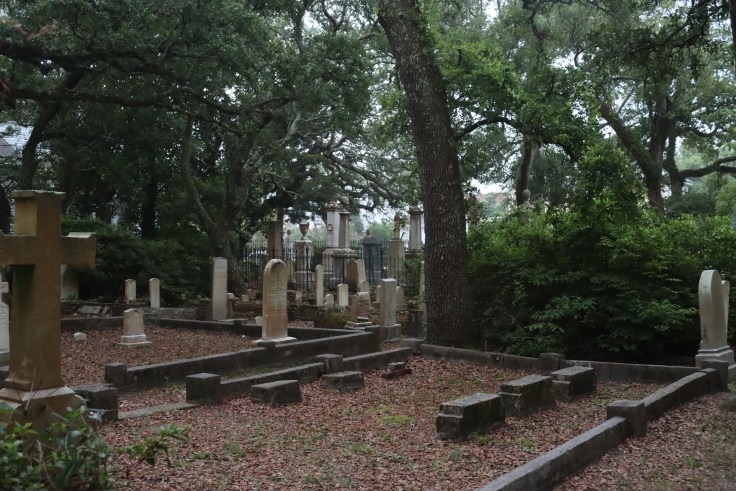
In June, my husband, kids, and I explored the coastal town of Beaufort, North Carolina, the third oldest community in the state. We’d been to the town many times before, but we’d never stopped in its cemetery. It’s so old that instead of being called a cemetery, it’s the Old Burying Ground. With the sky turning black as a storm approached, we ventured into the dim graveyard, the thick tangle of live oak branches pressing in around us, adding a ton of atmosphere.

No pictures or virtual tour could replicate what we experienced that day.

Five Benefits of Walking Your Setting

  • Walking slows me down. Even if I’m looking for a setting for a car chase, I still want to walk it. Walking helps me sees details I wouldn’t notice if I drove by or looked at photos. It also slows down my brain, allowing me to appreciate my surroundings.
  • Walking allows me to use all five senses. The photos above a can’t convey the hush of the cemetery, which contrasted with the strengthening winds, or the crackle of dead leaves underfoot, or the smooth surface of the marble headstones.
  • Walking allows me to absorb the atmosphere. That probably sounds artsy, but I think creative people know what I mean. Most locations give you a certain feeling. A doctor’s office might give me an uneasy feeling, and I can’t figure out why until I realize it has some similarity to an office where I had an unpleasant experience. It helps my writing if I give my setting a mood as well as a physical description. Experiencing the atmosphere of places in reality enormously aids my ability to create moods for my settings.
  • Walking gives me confidence when writing. Because I’ve actually visited the places I’m writing about, I can write with confidence. If someone thinks it’s unbelievable that a character can’t get cell reception to call for help in an Ohio state park, I know he’s mistaken because because I’ve been to Ohio state parks that don’t have reception.
  • Walking is cheap. If it’s difficult for you to travel for research, walking settings where you live or ones you visit regularly saves you both time and money. When I had to find a town outside of Ohio in which my main character Rae finished high school, I picked the coast of North Carolina because we have vacationed there.

If you write science fiction or fantasy or historical fiction, try to find some equivalent in the current, real world. If your space opera occurs on a desert planet, arrange a visit to a desert. If your historical romance takes place in Victorian London, and you live nowhere close to Great Britain, find a city that still has Victorian architecture. Or a living museum where guides dress and act like people from the period. If the princess-in-disguise from your fantasy hides out in a stable, volunteer to work in one.

For more tips on writing about settings, click here.

Do you walk your settings? How has walking inspired your writing?

Powered by WordPress.com.

Up ↑