
The first novel I ever wrote was set in West Virginia. I loved the area near the shoulder of the eastern panhandle, the mountains rising and falling like enormous whales in a deep green sea. I got a general sense of the area, but I didn’t pay attention to the details in nature.
When I wrote my novel, I didn’t dig into my setting and learn the names of the plants that grew and flowered in July in that area. I just wrote that trees hung heavy with rain or weeds brushed against a truck. I thought being specific was boring and unnecessary, that it would slow down the storytelling.
Then my freelance editor told me that readers appreciate details as long as I dribble it in and not dump it. Readers might not know exactly what a flowering rhododendron looks like, but if I write “the white blossoms drooped, with the weight of rain”, they have something to hang their imaginations on.
Because my mysteries are set in rural areas, I try to pay attention to the details in nature. My oldest, Bird Boy, has recently discovered the joy of birding. I am learning all about the birds that live and pass through Ohio.
If my character is also a birder, she wouldn’t say “a bird flew by in a blur.” She’d say “the tiny black and yellow blur of a golden-cheeked warbler zipped past my face.” I can even work in the details if my character is a city slicker. “A tiny black and yellow blur passed millimeters from my eyes. It seemed to be a bird. I hoped it wasn’t a typical of the wasps around here.”
Nothing beats walking the natural setting of a story. But if that’s impossible, or I need to conduct further research after I’ve visited an area, I have a few sources I turn to. I’m old-fashioned. I go to books first for my research.

Field guides are invaluable for checking on the appearance, habitat, and growing habits of plants and animals. Another great source are the magazines published by state departments of natural resources. We subscribed to ones from Ohio and West Virginia. I’ve learned so much from reading these publications.

For more inspiration from nature, click here to read my post on how weather lore can provide writing inspiration.
Do you pay attention to the details in nature? How can you work them into your stories?

 This month, my theme is poetry and figurative language. Here’s my haiku to celebrate the new season. IF you write a haiku, feel free to share it below in the comments.
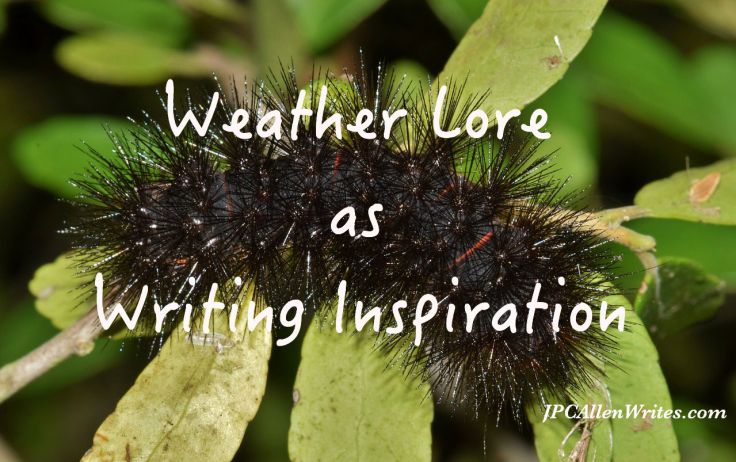 Many of us, at least in North America, have heard the weather lore of seeing how fuzzy the coat of a “woolly bear” caterpillar is to determine how severe the upcoming winter would be. Fuzzier coat, worse winter.
 As we wrap up the nature theme for the month, I wanted to share one of my favorite nature experiences. I’ve already written about some of mine:
 Some of my favorite experiences in nature occurred on clear nights with a full moon. If you haven’t been out on a night like that, with no artificial light nearby, I highly recommend finding an opportunity to do so. Artificial lights dampen or kill the wonder of a full moon night.

